Physicists Trap Single Antielectron, Paving Way for Gravity Tests of Antimatter
CERN physicists have confined a single positron for 12 hours, creating the first stable platform to test antimatter’s response to gravity.
S
··2 min readSciTech Editorial Team
Newsroom

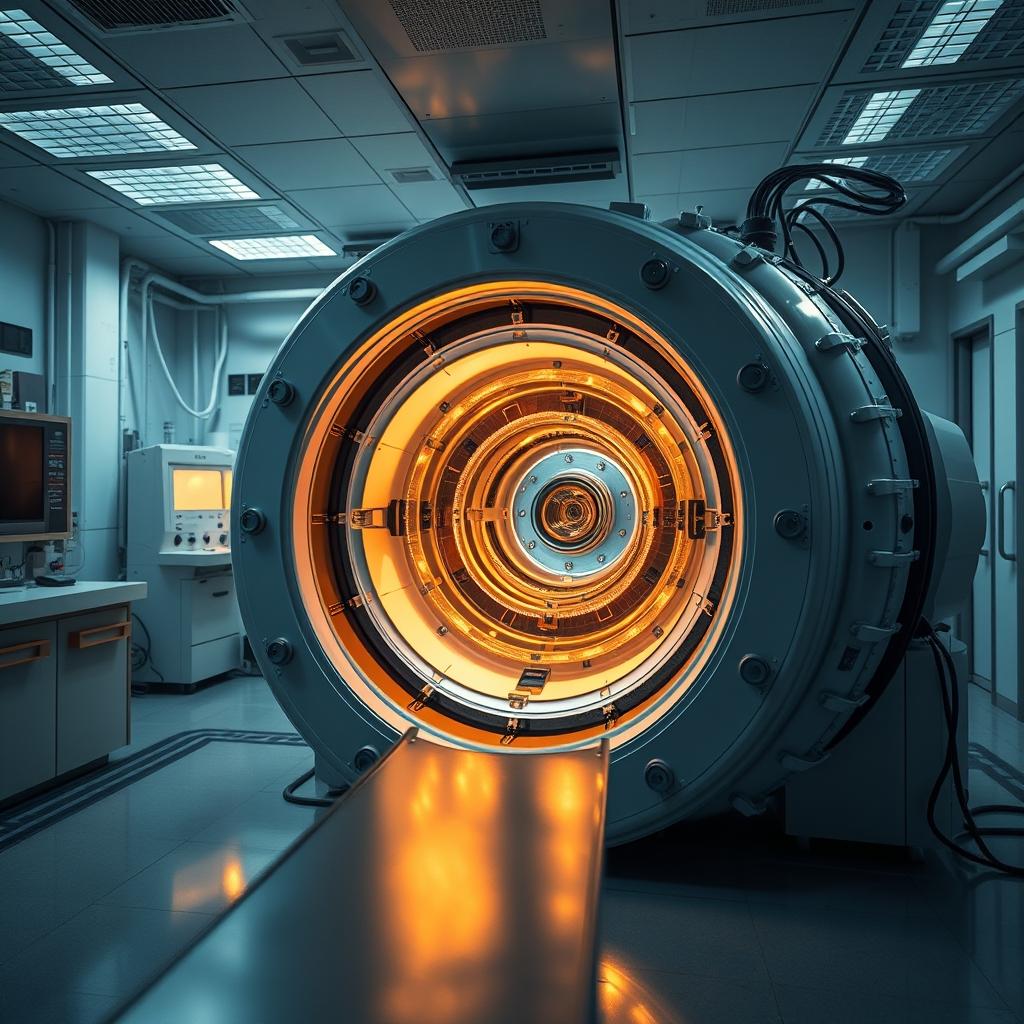
In a landmark announcement on 21 October 2026, physicists at CERN reported the successful confinement of a single antielectron – the positron – inside a cryogenic Penning-Malmberg trap for a continuous 12‑hour period. The achievement provides the first stable platform for precision studies of antimatter’s response to Earth’s gravity, a question that has lingered since the inception of particle physics.
The experiment combined a 5‑tesla superconducting magnet with ultra‑high vacuum (below 10⁻¹⁴ mbar) and laser‑cooling techniques that reduced the positron’s kinetic energy to a few millikelvin. By applying carefully tuned electric potentials, the team isolated the particle in a magnetic bottle, monitoring its charge‑to‑mass ratio with a relative uncertainty of 1 × 10⁻⁹. The unprecedented confinement time allowed repeated measurements of the positron’s cyclotron frequency, confirming that its fundamental properties match those of the electron to within experimental limits.
“Capturing a single positron for this length of time is a technical tour de force,” said Dr. Elena García, lead scientist of the Antimatter Gravity Initiative. “It validates the design of our trap and opens the door to a direct free‑fall measurement, something that was previously deemed impractical due to annihilation risks.” The team also highlighted the role of a novel silicon‑based detector that recorded annihilation events with nanosecond precision, ensuring that the particle remained intact throughout the observation.
Beyond the immediate goal of testing the weak equivalence principle for antimatter, the result has far‑reaching implications for the Standard Model and cosmology. If positrons are found to fall at a different rate than electrons, it would signal a violation of CPT symmetry and could help explain the observed matter‑antimatter asymmetry in the universe. Conversely, confirming identical gravitational behavior would tighten constraints on speculative theories that invoke antimatter as a component of dark matter.
Looking ahead, CERN plans to release the trapped positron in a vertical free‑fall chamber later this year, comparing its trajectory with that of a hydrogen atom under identical conditions. The next milestone is to achieve a measurement precision better than 0.1 % on the gravitational acceleration of antimatter, a target the collaboration believes is attainable within the next two years. Overcoming residual magnetic field gradients and further reducing background annihilation remain the primary technical challenges.