Lumina Simulation Unveils the Early Universe at Unprecedented Scale
Lumina, the new early‑universe simulation, matches JWST observations and offers a massive data set for cosmology.
S
··1 min readSciTech Editorial Team
Newsroom
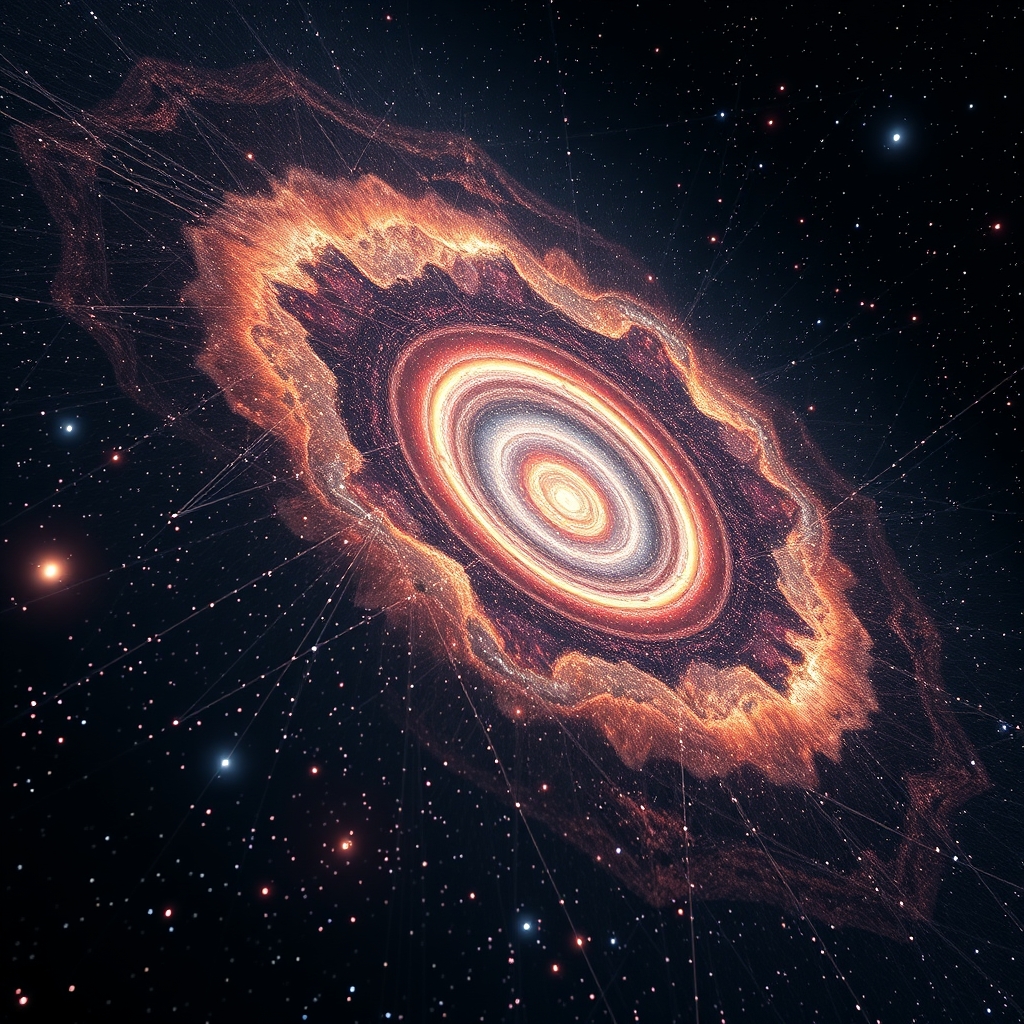
The Center for Astrophysics | Harvard & Smithsonian has unveiled "Lumina," a cosmological simulation that ranks among the largest and most detailed reconstructions of the early universe ever attempted. Developed to interpret the flood of high‑resolution observations from the James Webb Space Telescope (JWST) and the Nancy Roman Space Telescope, Lumina offers a virtual laboratory where astronomers can test theories against synthetic sky maps that mirror real data.
Lumina models a cubic volume of 1 gigaparsec (≈3.3 billion light‑years) on a grid of 2 trillion particles, achieving a spatial resolution of 5 kiloparsecs. The simulation was executed on the Frontier supercomputer, harnessing 27,000 GPUs for six weeks and generating roughly 2 petabytes of output. Built on the GADGET‑4 codebase, it incorporates the latest ΛCDM parameters, radiative transfer, and a sophisticated treatment of primordial chemistry.
Preliminary analysis shows that Lumina reproduces the observed luminosity function of galaxies at redshifts z ≈ 10‑12, captures the patchy progress of cosmic reionization, and predicts the spectral signatures that JWST and Roman are now detecting. "Lumina gives us a fully self‑consistent backdrop against which every faint galaxy and ionized bubble can be placed," says Dr. Emily Zhao, lead researcher on the project.
Beyond immediate interpretation, the simulation promises to refine estimates of dark matter density, the Hubble constant, and the timing of the first star formation episodes. Its public data release, scheduled for early 2027, will enable machine‑learning teams to train models on realistic cosmic environments, accelerating discovery across the field.
Looking ahead, the team plans to extend Lumina to later cosmic epochs, integrate feedback from black‑hole growth, and explore exotic physics such as dark‑matter annihilation. By bridging observation and theory at an unprecedented scale, Lumina is poised to become a cornerstone of 21st‑century cosmology.