Astronomers Unveil Twin Supermassive Black Holes Shining Within a Young Galaxy
A pair of supermassive black holes, each outshining its host galaxy, has been found less than a billion years after the Big Bang, challenging early‑universe growth models.
S
··1 min readSciTech Editorial Team
Newsroom
Astronomers have identified a pair of supermassive black holes (SMBHs) embedded in a single galaxy that existed less than one billion years after the Big Bang. Each object outshines every star in its host, establishing a record for luminosity at such an early cosmic epoch.
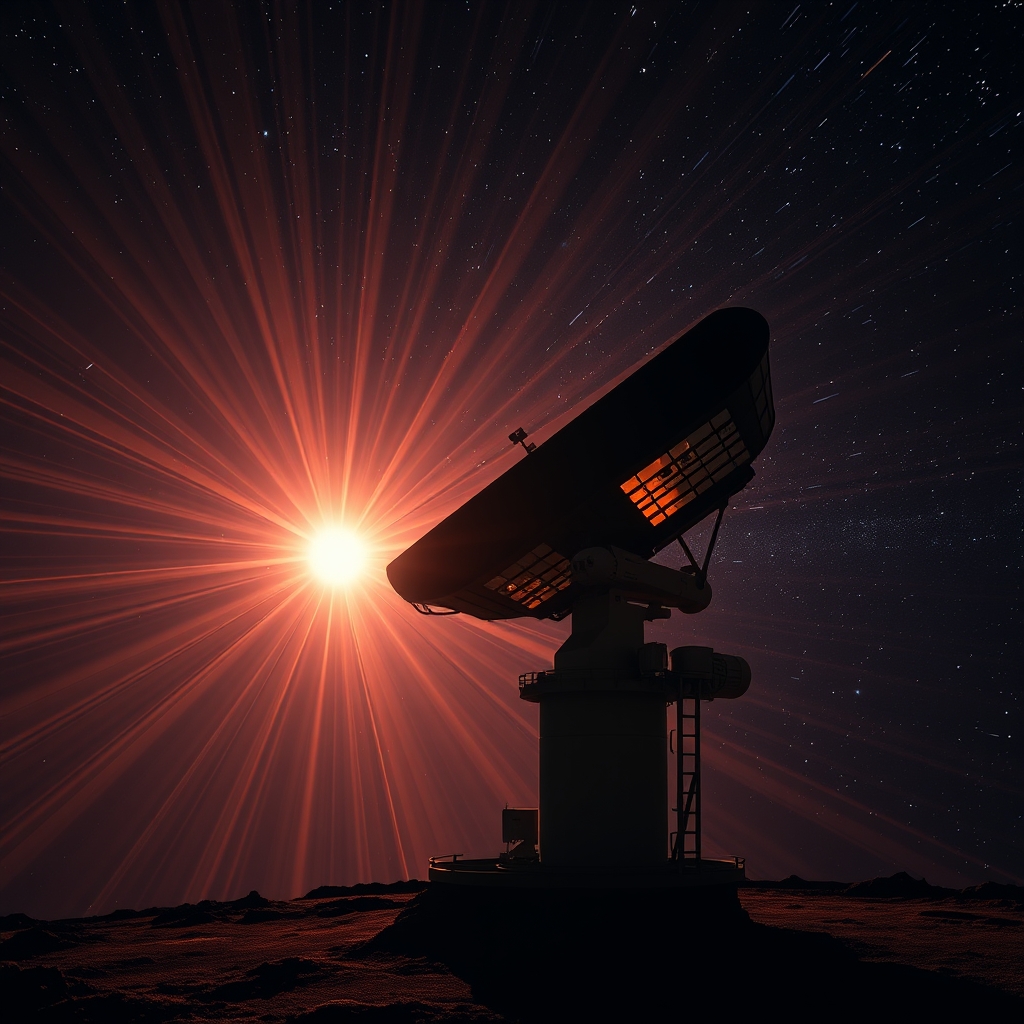
The discovery stems from deep‑field observations with the Karl G. Jansky Very Large Array (VLA) and the Atacama Large Millimeter/submillimeter Array (ALMA). Spectroscopic measurements place the system at a redshift of z ≈ 6.2, corresponding to roughly 0.9 Gyr after the Big Bang. The two quasars, separated by only about 5 kiloparsecs, exhibit bolometric luminosities exceeding 10^13 L☉, implying black‑hole masses of several hundred million solar masses.
According to Dr. Sara Onorato, lead author of the study, “the simultaneous brightness of both nuclei challenges conventional models that assume a single dominant black hole in nascent galaxies.” The close proximity suggests a rapid merger scenario, where hierarchical assembly of massive structures proceeds far earlier than previously thought.
The finding forces a reassessment of black‑hole growth mechanisms. If such massive objects can form within the first gigayear, accretion rates must have approached or exceeded the Eddington limit, or alternative channels such as direct‑collapse black‑hole seeds may dominate. Upcoming observations with the James Webb Space Telescope (JWST) and the Extremely Large Telescope (ELT) will probe the host galaxy’s stellar content and gas dynamics, testing these hypotheses.
Looking ahead, the binary system offers a promising target for low‑frequency gravitational‑wave observatories like LISA, which could directly detect the inspiral of the two SMBHs. As the universe continues to reveal its earliest chapters, each new detection reshapes our narrative of cosmic evolution.