FASER Collaboration Reports First Null Result in Search for 'Quirks' at LHC
The FASER Collaboration at the LHC reports its first results, finding no evidence for hypothetical 'quirk' particles that could explain the weakness of gravity.
S
··2 min readSciTech Editorial Team
Newsroom
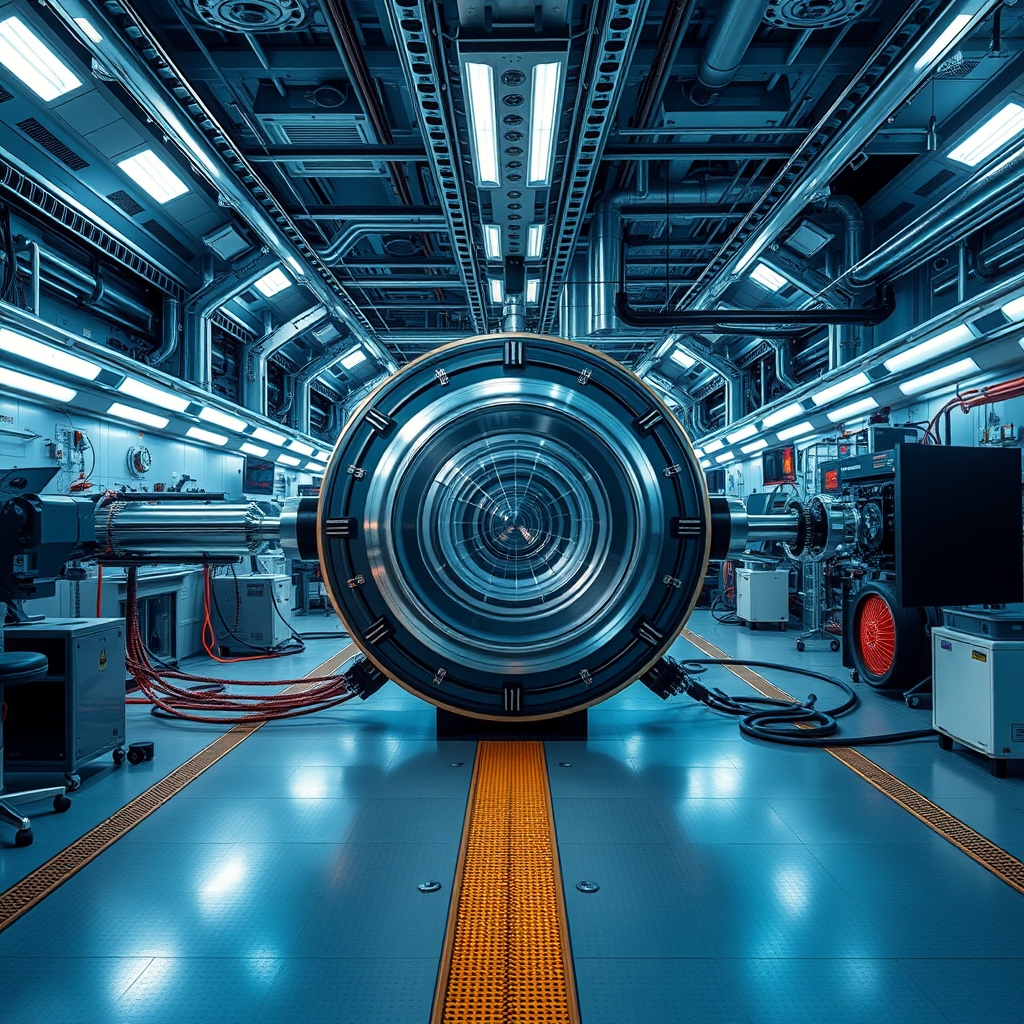
In a significant development for particle physics, an international collaboration of physicists has presented its first results in the search for hypothetical particles known as 'quirks.' These elusive particles are proposed to explain the vast disparity between the strength of gravity and the three fundamental forces described by the Standard Model. The findings, released following three years of meticulous data collection at the Large Hadron Collider (LHC)'s FASER experiment, mark a critical milestone in the ongoing quest to understand the fundamental structure of the universe.
The FASER Collaboration, dedicated to exploring the forward region of the LHC, analyzed extensive datasets to detect signatures of these heavy, slow-moving particles. Despite the high sensitivity of the detector and the rigorous methodology employed, the team found no evidence for the existence of quirks within the current experimental limits. This null result is not a failure but a crucial step in narrowing down the parameter space where these hypothetical particles might reside, thereby constraining theoretical models that predict their existence.
The search for quirks is driven by the need to address one of the most profound puzzles in modern physics: the hierarchy problem. Gravity is significantly weaker than the other fundamental forces, a discrepancy that remains unexplained by the Standard Model. Quirks, if they exist, would interact via a new fundamental force, potentially bridging this gap and offering insights into new physics beyond our current understanding. The FASER experiment is uniquely positioned to detect such particles due to its location in the forward direction, where high-energy collisions produce a dense flux of neutrinos and other particles.
The implications of these initial results are far-reaching for the broader physics community. By ruling out certain mass ranges and interaction strengths, the collaboration provides valuable constraints for theorists working on extensions of the Standard Model. Future runs of the LHC, with increased luminosity and improved detector capabilities, will allow for more sensitive searches. The FASER Collaboration plans to continue its analysis, aiming to push the boundaries of detection and potentially uncover evidence for new fundamental forces or particles in the coming years.