Massive Black Holes Excluded as Dark Matter Candidates by New Study
New analysis rules out super‑massive black holes as dark‑matter candidates, tightening constraints on the Universe’s missing mass.
S
··1 min readSciTech Editorial Team
Newsroom
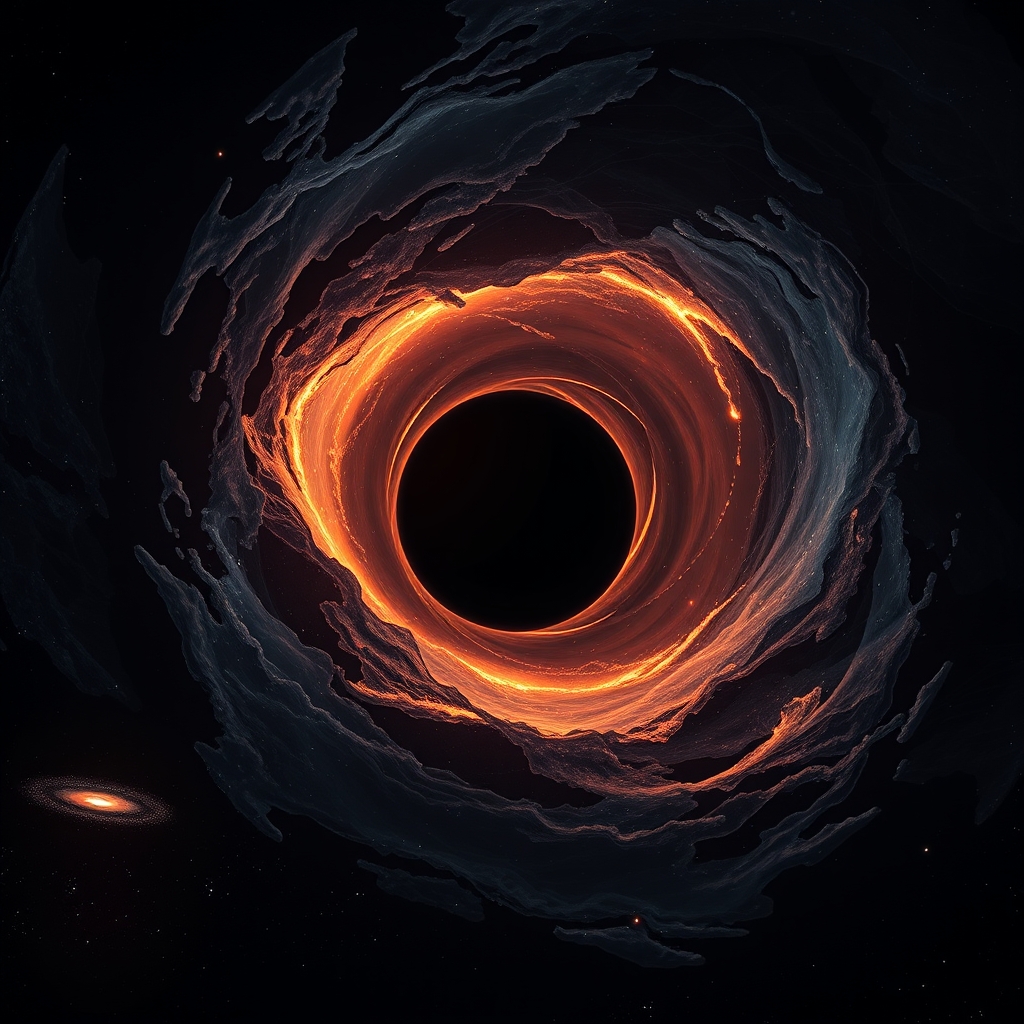
A team of cosmologists led by C. Gerlach and colleagues has delivered a decisive blow to one of the longest‑standing dark‑matter hypotheses: that the Universe’s missing mass could be made up of “stupendously” massive black holes. Published in Physical Review Letters, the work shows that such objects cannot account for the observed dark‑matter density, narrowing the field of viable explanations.
The researchers combined the latest gravitational‑wave catalog from LIGO‑Virgo‑KAGRA with precise measurements of the cosmic microwave background and extensive microlensing surveys. By modelling the merger rate of black holes across a mass range from 10⁵ to 10¹⁵ solar masses, they derived stringent upper limits on the fraction of dark matter that could be bound in these behemoths. Their statistical analysis incorporated Bayesian inference to quantify the confidence level of the exclusion.
“If primordial black holes of this scale existed in sufficient numbers, they would leave unmistakable imprints on both the stochastic gravitational‑wave background and the distribution of distant quasars,” explained Dr. Y. Gouttenoire, co‑author. “Our analysis finds no such signatures, effectively ruling out black holes heavier than about 10⁹ M☉ as viable dark‑matter candidates.” The team emphasized that the null result is robust against variations in the assumed black‑hole formation scenarios.
The exclusion reshapes the dark‑matter landscape, narrowing the field to particle‑based candidates such as weakly interacting massive particles (WIMPs) or axions, and to more exotic possibilities like fuzzy dark matter. It also sharpens the goals of upcoming surveys, including the Euclid mission and the Vera C. Rubin Observatory, which will probe the remaining parameter space with unprecedented sensitivity.
Future work will focus on extending the analysis to intermediate‑mass black holes and on testing alternative formation channels. For now, the study underscores that even the most massive black holes cannot hide the Universe’s darkest secret, steering theoretical and experimental efforts toward new frontiers.