Webb's 'Little Red Dots' Mystery Solved: Simulations Reveal Origins of First Supermassive Black Holes
New simulations suggest JWST's 'little red dots' are the birthplaces of the first supermassive black holes, resolving a major mystery of the early universe.
S
··2 min readSciTech Editorial Team
Newsroom
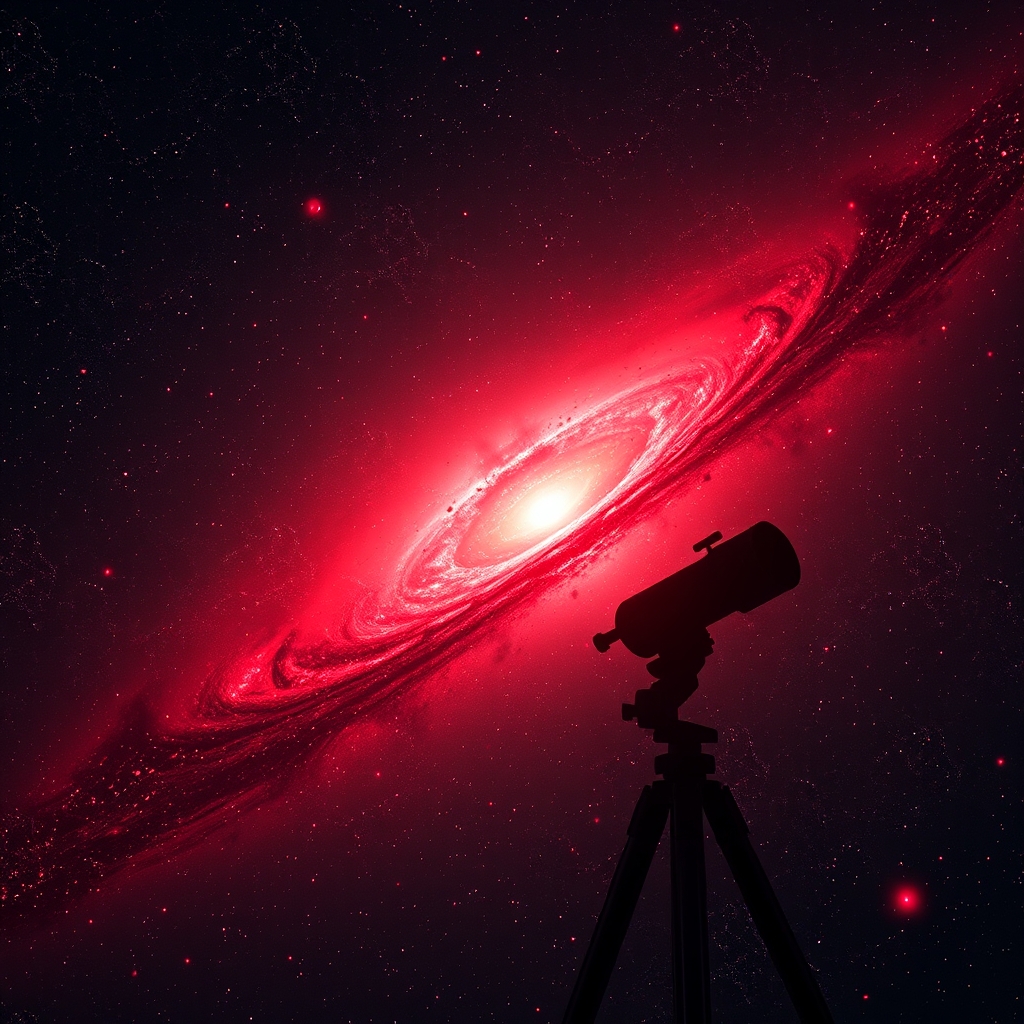
Astronomers have potentially resolved one of the most persistent mysteries uncovered by NASA's James Webb Space Telescope (JWST) by identifying the enigmatic "little red dots" (LRDs) as the birthplaces of the first supermassive black holes. This breakthrough addresses a significant gap in our understanding of the early universe, where the rapid formation of these colossal gravitational entities has long defied conventional astrophysical models. By leveraging sophisticated numerical simulations, researchers have provided a compelling narrative that links these faint, reddish objects to the initial stages of black hole growth in the cosmos's infancy.
The investigation utilized high-fidelity computational models to simulate the conditions of the early universe, specifically focusing on the dynamics of gas clouds and the formation of massive stars. The simulations demonstrated that LRDs are not merely background noise or unrelated artifacts, but rather dense regions where matter accumulates rapidly, leading to the collapse of stars into supermassive black holes. This finding aligns with observational data from JWST, which detected these objects at high redshifts, indicating they existed when the universe was less than a billion years old. The red coloration is attributed to the absorption of blue light by dust and the emission from hot gas surrounding the forming black holes.
The implications of this discovery are profound for cosmology and astrophysics. If LRDs are indeed the nurseries of supermassive black holes, it suggests that these gravitational giants formed much earlier and more rapidly than previously thought. This challenges existing theories regarding the timescales required for black hole growth, which typically rely on the slow accretion of matter over millions of years. The new model proposes a more efficient mechanism, possibly involving direct collapse of gas clouds, which could explain the presence of such massive objects in the distant past. This shift in perspective may necessitate a reevaluation of standard models of galaxy formation and evolution.
Furthermore, this research opens new avenues for future observational campaigns. Astronomers can now target specific LRDs for detailed spectroscopic analysis to confirm the presence of high-velocity gas outflows and other signatures of active black hole growth. Upcoming missions, including the Nancy Grace Roman Space Telescope, are expected to provide deeper insights into the population statistics of these objects. By understanding the physical processes driving LRD formation, scientists can better comprehend the co-evolution of galaxies and their central black holes, a fundamental aspect of modern astrophysics. This milestone not only solves a specific observational puzzle but also refines our broader theoretical framework for the history of the universe.