Europa Clipper: Engineering a Radiation-Resistant Path to Jupiter's Icy Moon
NASA's Europa Clipper uses a gravity-assist trajectory and radiation-hardened electronics to explore Jupiter's moon Europa and search for subsurface life.
S
··2 min readSciTech Editorial Team
Newsroom
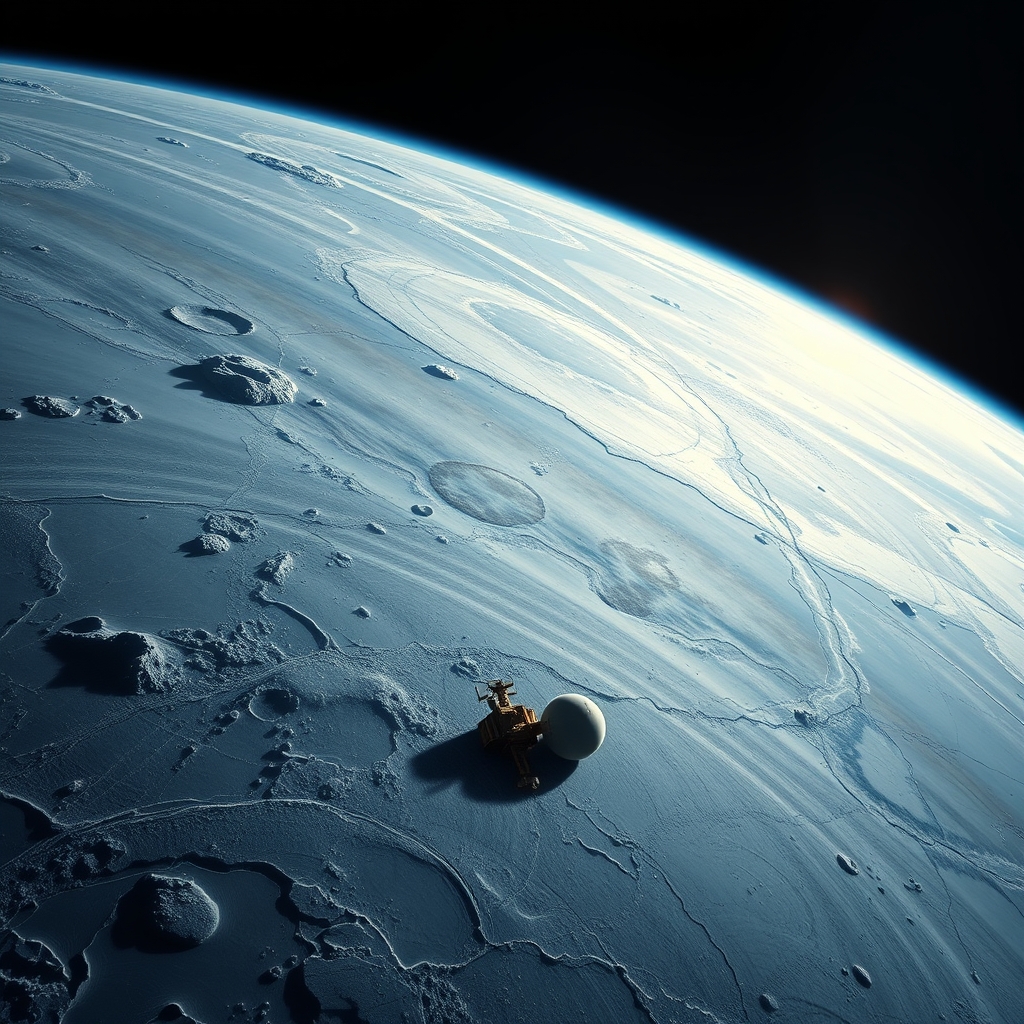
On December 3, 2026, a 30.5-meter-wide space probe will execute a critical slingshot maneuver past Earth, accelerating on its journey to reach Jupiter by 2030. The Europa Clipper, designed to investigate Jupiter’s enigmatic moon Europa, aims to identify regions within the moon’s subsurface ocean that could potentially harbor life beneath its thick ice shell. Tim Larson, the project manager at the Jet Propulsion Laboratory, has outlined the intricate engineering challenges involved in designing and flying this ambitious mission.
The mission’s trajectory is a direct result of the energy provided by the Falcon Heavy launch vehicle, which set a Mars-Earth Gravity Assist (MEGA) path. Approximately four months after launch, the spacecraft will fly by Mars to gain velocity, followed by a final gravity assist from Earth to enter its outbound trajectory toward Jupiter. This roundabout route is essential for achieving the necessary speed without expending excessive fuel.
A primary challenge in mission design was the intense radiation environment surrounding Jupiter. Larson explains that a spacecraft orbiting Europa directly would not survive the harsh conditions for long. Consequently, engineers adopted a flyby concept, where the probe will orbit Jupiter for three weeks at a time, with the orbit synchronized so that Europa is present during each pass. This approach allows the spacecraft to spend minimal time in high-radiation zones while relaying data from safer parts of the orbit.
Power generation also presented unique hurdles. While earlier concepts for orbiting Europa relied on radioisotope thermoelectric generators (RTGs) due to Jupiter’s shadow, the shift to a flyby mission made solar power feasible. The spacecraft utilizes massive solar arrays to generate the required energy, adhering to national policies that restrict RTG use to absolute necessities.
To withstand the cosmic environment, the Europa Clipper’s electronics are housed in a specialized module known as 'the vault.' Components within this module are designed to withstand an exposure of 150 kilorads (1,500 sieverts), with parts rated for 300 kilorads to maintain a standard factor-of-two safety margin. This high-radiation tolerance required modifications to circuit designs and component form factors, presenting significant engineering side challenges.
Finally, preserving technical knowledge over the mission’s multi-year duration is a priority. The team documents spacecraft idiosyncrasies in databases and manages personnel turnover through extensive overlap. Larson notes that they are also exploring how artificial intelligence can process this broad array of information across various formats to extract critical insights for mission operations.